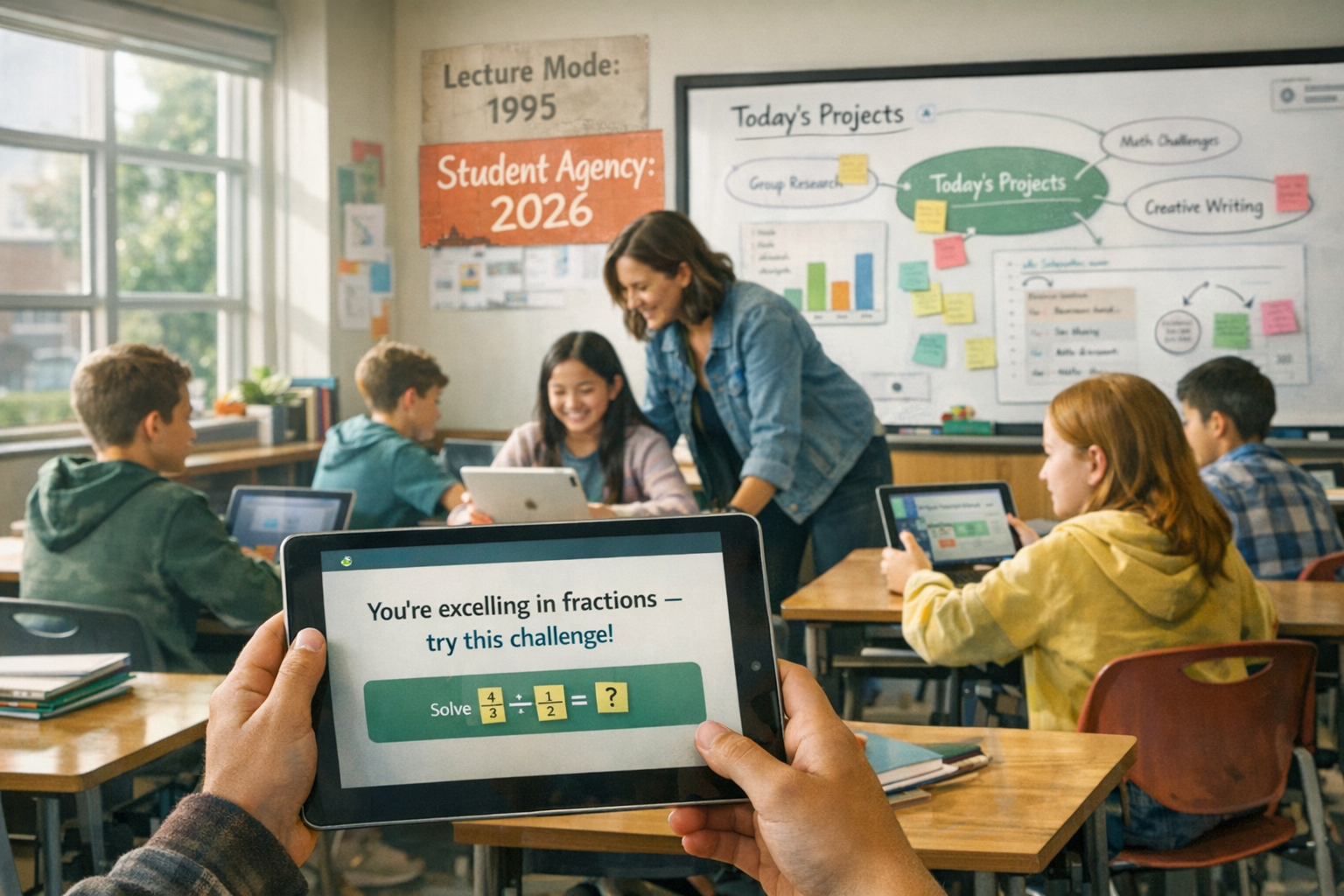
Let’s be real: AI in schools right now feels a lot like the early days of interactive whiteboards. Everyone’s excited. Everyone’s trying it. But most people are just using it to do the same old things — faster.
That’s the “playback trap.” You take a lecture, a worksheet, or a quiz — and you digitize it with AI. It’s slicker, sure. But it doesn’t change how students learn. It doesn’t make them think deeper. It doesn’t give them agency.
And that’s exactly what educator and author Catlin Tucker is warning against: using technology to reinforce passive, teacher-led models instead of transforming them.
If we’re not careful, AI won’t revolutionize education — it’ll just make the old system more efficient.
The Problem: AI as a “Playback” Tool
In schools, the mistake was rolling out tablets and smartboards — only to have teachers keep lecturing while students passively watched. The tech didn’t change the model — it just made the lecture shinier.
In classrooms today, we’re doing the same thing with AI:
- Using AI to generate worksheets — but still assigning them as busywork.
- Deploying chatbots to answer questions — but not using them to spark curiosity or critical thinking.
- Automating grading — but not changing how feedback is given or how students reflect on their learning.
We’re not transforming. We’re just playing back the same old lessons — with better graphics.
The Solution: Put Students — Not Tech — at the Center
Tucker’s core message is simple: technology should put learners at the center of the experience.
That means:
1. Stop Automating Passive Learning
Before you plug AI into your lesson plan, ask: Is this activity even worth automating? Maybe the real problem isn’t speed — it’s that students are just copying answers, not thinking.
Use AI to rethink the task, not just speed it up. Turn a multiple-choice quiz into a reflective journal prompt. Turn a worksheet into a student-led research project.
2. Empower Students — Don’t Replace Them
AI shouldn’t make students obsolete. It should make them more curious, more capable, more in control. Give them tools that help them explore, create, and question — not just regurgitate.
Think of AI as a co-pilot — not a replacement for student thinking.
3. Build for Agency, Not Just Accuracy
In education, the goal is learner agency — students making choices, driving their own learning. AI should support that.
Can students use AI to:
- Choose their own research topics?
- Design their own assessments?
- Get personalized feedback that helps them grow — not just a grade?
If not, you’re not using AI to its full potential.
4. Measure Transformation — Not Just Completion
Don’t just track how many assignments were graded or how fast quizzes were completed. Track how many students asked deeper questions. How many took risks. How many showed growth in critical thinking or creativity.
If AI isn’t changing how students think — it’s not transforming.
What Educators Can Do Right Now
You don’t need a $1M AI budget to start. Here’s how to begin:
- Audit your top 3 “worksheet” activities — which ones are ripe for redesign, not just digitization?
- Pilot AI with a student-centered goal — not “let’s generate more worksheets,” but “let’s help students explore their own questions.”
- Teach students to ask “why?” — not just “what’s the answer?” When AI gives a response, teach them to dig into the “why” behind it.
- Start small, scale smart — pick one lesson, one class, one project. Prove value, then expand.
One teacher I spoke with used AI not to generate worksheets — but to help students write personalized learning plans based on their interests. That’s transformation. That’s agency. That’s what AI should be doing.
Final Thought
AI in schools isn’t about replacing teachers. It’s about replacing outdated thinking.
If we use AI to just do what we’ve always done — faster — we’ll miss the real opportunity: to build classrooms where students are curious, capable, and in control of their own learning.
And if we get this right — we won’t just be teaching better. We’ll be preparing students for a future that doesn’t yet exist.
Share:
Rethinking Middle School Scheduling: What Finance Teams Can Learn from Education Reform
Game-Based Learning 2026: How Play Is Reshaping Education, Health, and Career Readiness