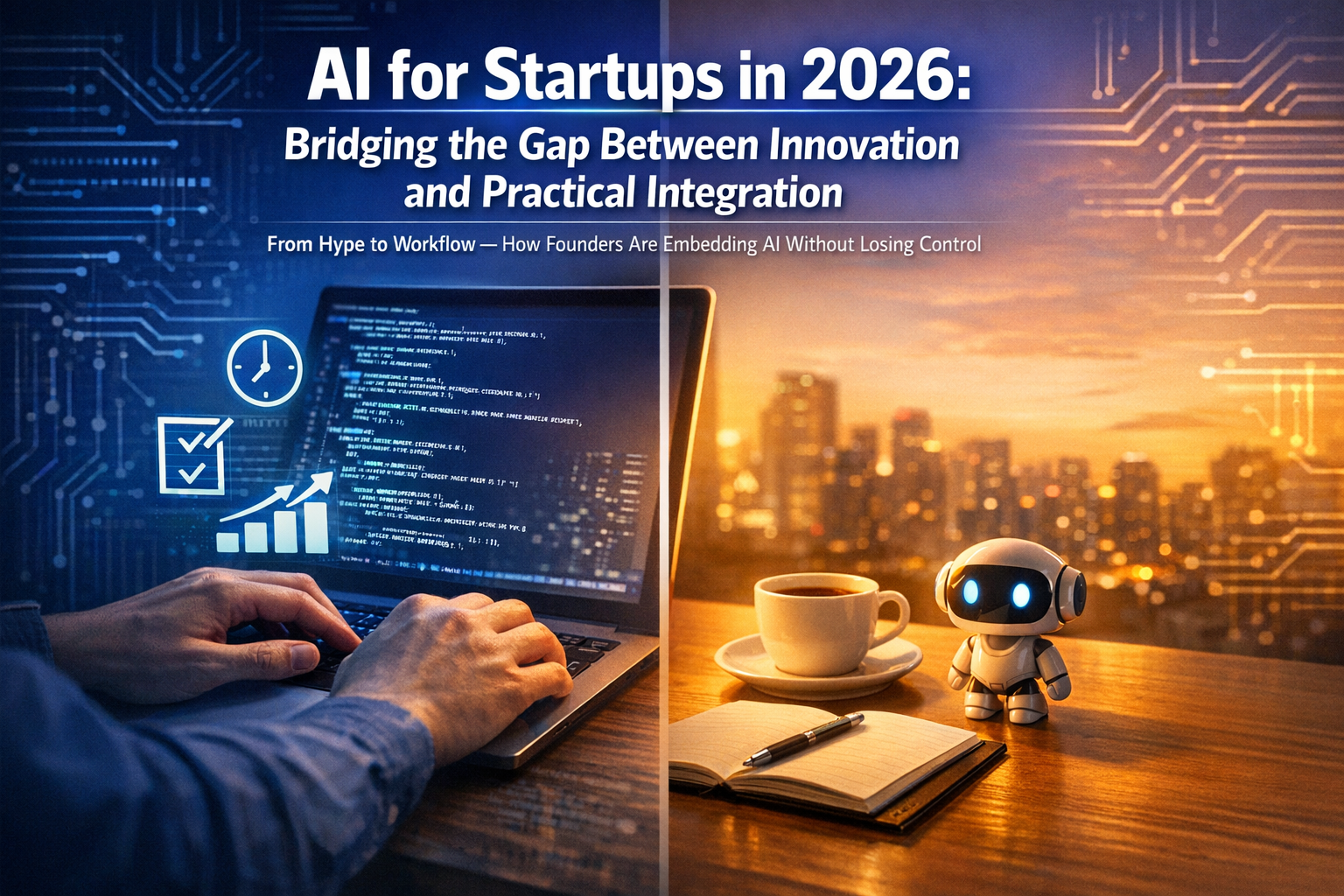
AI Startups in 2026: Separating Hype From Opportunity
The artificial intelligence landscape in March 2026 presents a paradox. While major companies like OpenAI announce massive compute investments—with plans to spend $600 billion on infrastructure by 2030—the actual productivity gains remain slower than expected. For startups, this gap isn't a problem. It's an opportunity.
The challenge isn't whether AI works. It's how to integrate it into workflows in ways that deliver measurable results. Founders who understand this distinction will thrive in 2026 and beyond.
The AI Productivity Gap: Where Startups Win
Two competing narratives are dominating AI discussions in March 2026. On one hand, there's genuine excitement about AI's technical capabilities—natural language processing, image generation, predictive modeling, and automation. On the other hand, skeptics point out that despite these advances, widespread productivity gains remain elusive.
This disconnect creates a unique window for startups. While enterprises struggle to integrate AI at scale, nimble founders can experiment with emerging tools and frameworks, testing what actually works before the market consolidates.
The key insight? Don't wait for the perfect AI solution. Start experimenting with what's available now.
Emerging AI Applications Startups Should Explore
AI-Driven Regulatory Compliance
One of the most promising areas for startup innovation is AI-powered compliance. Industries like finance, healthcare, and intellectual property face complex, ever-changing regulations. Startups that build AI tools to automate compliance workflows can solve a genuine pain point.
For example, companies are using AI to monitor regulatory changes, flag compliance risks, and generate required documentation—tasks that traditionally consume enormous amounts of human time and resources.
Ethical AI and Security
As AI becomes more powerful, misuse becomes a real concern. Cyberattacks leveraging AI chatbots, deepfakes, and automated social engineering are emerging threats. Startups that prioritize ethical AI frameworks—similar to approaches being developed by companies like Anthropic—will build trust with customers and differentiate themselves in crowded markets.
Ethical AI isn't just a moral imperative. It's a competitive advantage.
Personalized Education and Mentoring Platforms
AI is transforming how people learn and develop skills. Startups building personalized education platforms—combining AI with game dynamics, real-world scenarios, and adaptive learning paths—are tapping into a massive market. These platforms can serve entrepreneurs, professionals seeking upskilling, or students exploring new fields.
The key is making learning contextual, engaging, and measurable.
Multilingual and Localized AI Models
While global AI models dominate headlines, localized solutions are emerging. Startups in regions like India are building multilingual AI models tailored to specific languages, cultural contexts, and regional needs. This approach opens entirely new markets and addresses the limitations of one-size-fits-all AI solutions.
Practical Strategies for Startup Founders
Embed AI Into Repetitive Tasks
The most immediate way startups can benefit from AI is by automating repetitive, low-value work. This includes:
- Customer segmentation and targeting
- Fraud detection and anomaly monitoring
- Predictive supply chain optimization
- Marketing copy generation and A/B testing
- Data entry and document processing
By freeing up human time from these tasks, teams can focus on strategy, creativity, and customer relationships.
Maintain Human Oversight for Critical Decisions
Here’s where many startups go wrong: they treat AI as a replacement for human judgment. It’s not. AI excels at pattern recognition and optimization, but humans are essential for:
- Ethical decision-making
- Creative problem-solving
- Client relationships and negotiations
- Strategic pivots during uncertainty
- Stakeholder communication
The winning formula is AI as a co-founder, not a CEO. Use it to handle the heavy lifting of data, automation, and repetition—but keep humans in the driver’s seat for anything that involves values, nuance, or long-term consequences.
Start Lean with No-Code Tools
You don’t need a data science team to begin leveraging AI. Tools like Canva’s AI features, Zapier’s automation workflows, or Notion AI can deliver immediate value without requiring technical expertise. Start small. Test one workflow. Measure the impact. Scale what works.
Track, Don’t Just Use
AI adoption without measurement is wasted effort. Founders should embed KPIs into every AI experiment—from time saved to conversion rate lift to error reduction. If you can’t tie AI to a tangible outcome, you’re likely just adding complexity without value.
Rethink Your Team Structure
AI changes how teams operate. Instead of hiring for manual tasks, hire for interpretation, strategy, and oversight. Train your team to understand AI outputs—not just use them. This means investing in upskilling, especially in areas like prompt engineering, data literacy, and ethical AI use.
Common AI Mistakes Startups Make in 2026
Ignoring Security and Compliance
AI tools can be vulnerable to misuse, data leaks, or adversarial attacks. Startups that skip security frameworks or fail to audit their AI systems risk regulatory fines, reputational damage, or even shutdowns. Ethical guardrails aren’t optional—they’re foundational.
Blind Reliance on AI Outputs
AI isn’t infallible. It hallucinates, misinterprets context, and can amplify biases. Founders who treat AI outputs as gospel without verification risk making costly mistakes. Always validate AI-generated insights with real-world data or human review.
Under-Skilling Your Team
You can’t outsource understanding. If your team doesn’t know how to interpret AI models, they’ll misapply them—or worse, trust them blindly. Invest in training. Make AI literacy part of your onboarding and ongoing development.
Skipping the Pilot Phase
The Economist’s analysis of AI’s stalled productivity boom reminds us: no technology transforms overnight. Startups that skip pilot testing, fail to iterate, or rush to scale without validation often waste resources. Test small. Learn fast. Scale deliberately.
Final Takeaway: Treat AI as Your Experiment Engine
March 2026’s AI headlines aren’t about the next big model—they’re about the next big integration. The real winners won’t be the ones with the most advanced AI. They’ll be the ones who use it most effectively.
As Violetta Bonenkamp, founder of Fe/male Switch and CADChain, puts it: “Treat AI as your experiment engine, not a replacement strategy.” Embed it where friction exists—in compliance, scaling, personalization, and exploration. But always humanize the outcomes: customer experiences, high-stakes pivots, and stakeholder trust.
The future belongs to startups that don’t just adopt AI—but adapt it to their context, their customers, and their mission.
Citations:
Violetta Bonenkamp, “AI News | March, 2026 (STARTUP EDITION),” Mean CEO, March 1, 2026.
The Economist, “AI’s Productivity Boom Is Still Waiting,” March 2026.
Anthropic, “Ethical AI in Practice,” 2026.
Engadget, “AI Chatbots and Cybersecurity Threats,” March 2026.
Fe/male Switch, “AI-Driven Mentoring for Entrepreneurs,” 2026.
BharatGen, “Multilingual AI for India,” 2026.
Mean CEO, “Balancing AI and Human Oversight,” March 2026.
Canva AI, “No-Code Automation Tools,” 2026.
Mean CEO, “Measuring AI ROI,” March 2026.
Mean CEO, “Building AI-Ready Teams,” March 2026.
Anthropic, “Security Frameworks for AI,” 2026.
The Wall Street Journal, “AI Hallucinations and Business Risk,” March 2026.
Mean CEO, “Upskilling for AI Adoption,” March 2026.
The Economist, “Why AI Productivity Is Stalled,” March 2026.
Share:
Why Universities Are Switching to Device Subscriptions — And Why Your Business Should Too
B2B Tech Market 2026: 3% Growth Ahead — What Startups and Enterprises Need to Know