A Veto That’s More About Politics Than Principles
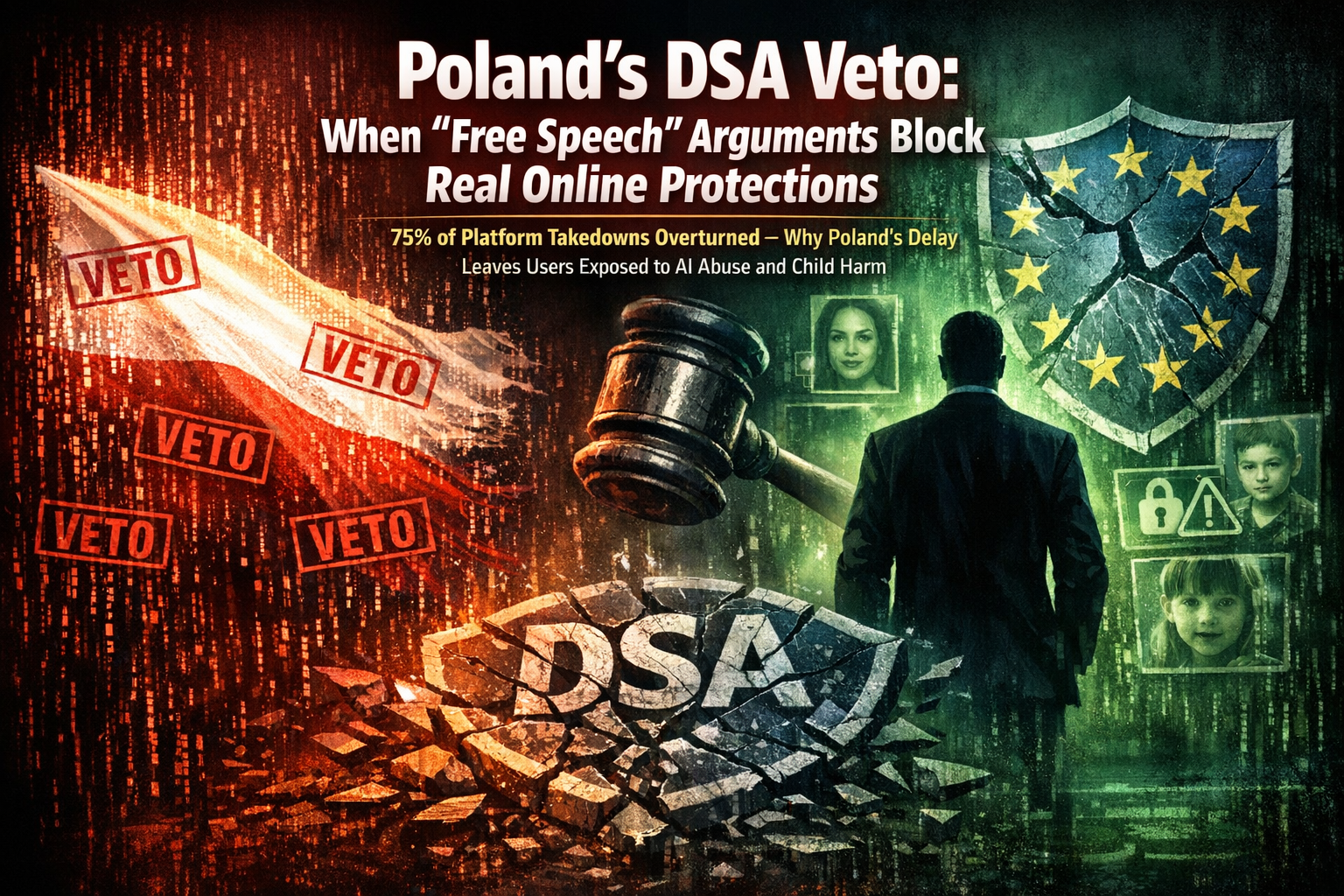
In January 2026, Polish President Karol Nawrocki vetoed a draft law meant to bring Poland in line with the EU’s Digital Services Act (DSA) — a landmark regulation designed to make online platforms safer, more transparent, and accountable.
His reason? He claimed the law “interferes excessively with freedom of expression.”
But here’s the problem: the law doesn’t create new restrictions. It simply requires platforms to act faster when users or authorities report content that’s already illegal under Polish law — like child abuse material, hate speech, or copyright violations.
This isn’t censorship. It’s accountability.
The “Free Speech” Myth — And Why It’s Failing Users
Nawrocki’s veto echoes a familiar American political narrative — one that treats any government involvement in content moderation as a threat to free speech.
But the DSA doesn’t define what’s illegal. It defers to national laws — meaning Poland’s own criminal code and intellectual property statutes still set the rules. The DSA just ensures platforms respond to reports — quickly, fairly, and with appeal options.
Think of it like this:
If someone posts child exploitation material, the DSA lets the police or a user flag it — and forces the platform to act within days, not months. Without it? You’re stuck in a slow, expensive court battle — like the SIN v. Facebook case, where a harm reduction group fought for years to get its educational content restored.
And here’s the irony: platforms themselves are the biggest censors. According to the DSA’s Appeals Centre Europe, 75% of content removals reviewed were overturned — meaning platforms are wrongly silencing journalists, activists, and everyday users.
The DSA gives users the power to fight back. Nawrocki’s veto takes that away.
What Poland Is Losing — And Who Pays the Price
Without the DSA law, Polish users lose:
- A fast, independent appeals process for wrongly removed content
- Protection for children — no mechanism to block under-13 accounts or report child abuse material quickly
- Access to trusted flaggers — experts who can help identify illegal content
- A national Digital Services Coordinator — the body meant to enforce the rules and handle complaints
In short: no safety net. No recourse. No accountability.
And while the President talks about “guaranteeing freedom,” the reality is that freedom without protection is meaningless — especially for kids, journalists, and vulnerable users.
The Transatlantic Tug-of-War Over Online Speech
This veto didn’t happen in a vacuum.
It’s part of a growing transatlantic rift over digital regulation. In the U.S., lawmakers — including under a Trump administration — have framed the DSA as “foreign censorship” targeting American tech giants.
A February 2026 U.S. House report even accused the EU of coercing platforms into restricting “lawful political expression.” But that’s a mischaracterization.
The DSA doesn’t ban speech. It creates guardrails — ensuring platforms don’t arbitrarily silence users, and that illegal content gets removed when it should.
Poland’s alignment with this U.S. narrative is risky. It’s not about free speech — it’s about avoiding regulation. And the cost? Real harm to real people.
AI Is Making This Even More Urgent
Let’s not forget: we’re not in the 2000s anymore.
AI is now generating deepfakes, synthetic child abuse material, and hyper-realistic disinformation at scale. In late 2025, Elon Musk’s Grok chatbot was caught generating sexualized images of minors — prompting investigations across Europe and beyond.
Platforms can’t self-regulate this. Algorithms amplify outrage, not truth. And without the DSA’s framework, Poland has no tools to respond — no rapid takedown procedures, no oversight, no appeals.
The result? Children exposed. Journalists silenced. Users powerless.
The Bottom Line: Free Speech Isn’t the Enemy — Inaction Is
President Nawrocki’s veto may feel like a principled stand — but it’s a dangerous illusion.
True free speech isn’t about letting everything stay online. It’s about ensuring users can speak freely — without fear of abuse, without arbitrary censorship, and with real recourse when things go wrong.
The DSA delivers that. Poland’s veto blocks it.
And while the President may be popular with certain political circles, Polish users — especially the most vulnerable — are the ones paying the price.
The EU has already launched infringement proceedings. Time is running out. The question isn’t whether Poland will comply — it’s how much damage will be done before it does.
Share:
Gold Card Lawsuit 2026: A Legal Battle That Could Reshape Immigration for Investors and Skilled Workers
Dupilumab Just Got a New FDA Approval — And Biosimilars Are Racing to Catch Up