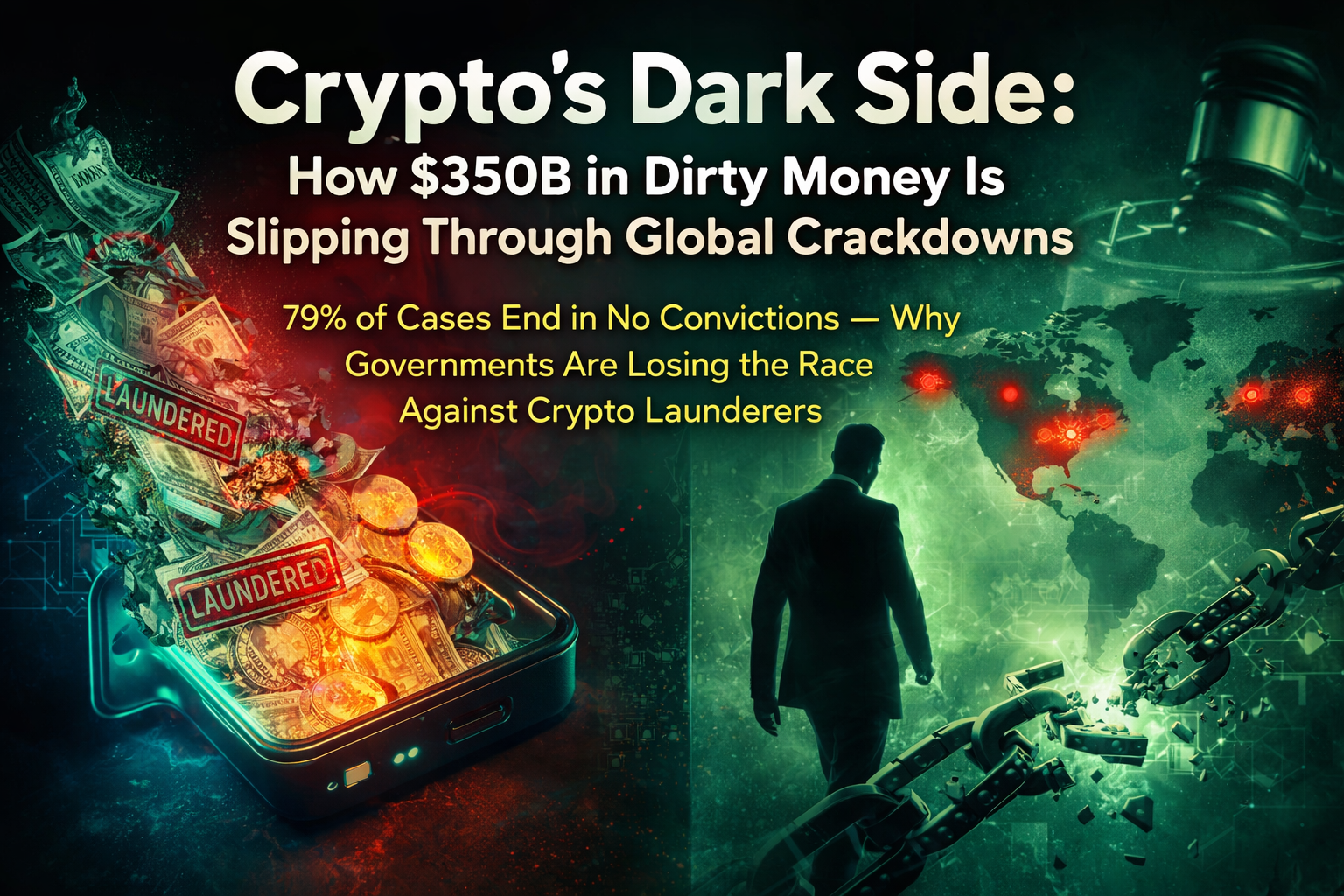
The $350 Billion Problem No One’s Solving
Cryptocurrency was supposed to be the future of finance — decentralized, transparent, and borderless. But for criminals and rogue regimes, it’s become something else entirely: the perfect tool for laundering dirty money.
A new report from the Henry Jackson Society reveals that $350 billion has been laundered through crypto over the past two decades — and the pace is accelerating. Worse? 79% of these cases ended with no convictions, and only 29% of stolen funds were ever recovered.
This isn’t just a tech problem. It’s a global security crisis — and Western governments are dangerously unprepared.
Who’s Behind the Crypto Laundering Wave?
The report, compiled by Alexander Browder (son of anti-corruption activist Bill Browder), analyzed 164 publicly documented money laundering cases between 2005 and 2025. The findings are stark:
- Russia is the epicenter — home to half of all illicit crypto exchanges and four out of five major ransomware groups.
- The U.S. and UK have the highest number of confirmed cases — but the weakest enforcement.
- Hydra Market, a Russian-based darknet marketplace, processed over $5 billion in illegal goods — from drugs to stolen data — before being seized in 2022.
Browder doesn’t mince words: “Criminals and rogue regimes are basically running circles around U.K., U.S. and EU prosecutors.”
And it’s not just criminals. Russia is using crypto to bypass sanctions imposed after its invasion of Ukraine — turning digital assets into a lifeline for its war economy.
Why Crypto Is the Perfect Tool for Money Launderers
Unlike traditional banking systems — where transactions are monitored, flagged, and frozen — crypto offers:
- Pseudonymity: Wallets don’t require real names.
- Speed: Cross-border transfers take minutes, not days.
- Decentralization: No single authority to shut it down.
- Lax regulation: Many exchanges operate in legal gray zones.
The Regulatory Lag: Governments Are Playing Catch-Up
While criminals evolve, regulators are stuck in the past.
In the U.S., the Department of Justice disbanded its crypto fraud unit in 2024 — just as illicit activity was surging. Meanwhile, President Trump’s ties to the crypto industry have drawn scrutiny, raising questions about political influence.
In the UK, Reform UK became the first major party to accept crypto donations — prompting calls for a ban. The Financial Conduct Authority won’t regulate crypto exchanges until 2027, leaving a dangerous gap.
As Chris Coghlan, MP and Treasury Select Committee member, put it:
“The sophistication and speed of crypto money launderers is much higher and faster than our government’s ability to react. Our sanctions and law enforcement are in an increasingly weak position to stop it.”
What Needs to Change — And Who Should Do It
The report’s authors aren’t just sounding the alarm — they’re offering solutions.
1. Create a Crypto Asset Recovery Office (UK)
A dedicated agency to:
- Track and seize stolen crypto
- Hold recovered funds
- Return them to victims
2. Close the Regulatory Loopholes
- Mandate KYC (Know Your Customer) for all crypto exchanges
- Require real-time transaction monitoring
- Enforce cross-border cooperation between regulators
3. Treat Crypto Like Real Money
Governments must legally recognize digital assets as personal property — so victims can sue, and prosecutors can seize.
4. Learn from the Dark Web’s Demise
Just as law enforcement dismantled Hydra and AlphaBay, they must now target crypto laundering hubs — not just the tools, but the infrastructure.
The Bottom Line: Crypto Crime Is a National Security Threat
This isn’t about Bitcoin or Ethereum. It’s about sovereign risk.
When hostile states like Russia use crypto to evade sanctions, it undermines global financial stability. When criminals launder billions with impunity, it erodes public trust in institutions.
The solution? Urgent, coordinated, global action — before the next $350 billion disappears into the digital ether.
Because right now, the bad guys aren’t just winning. They’re setting the rules. And if we don’t act, we’ll be cleaning up their mess for decades to come.
Share:
How North Korea Funds Its Regime Through Cybercrime — And What the World Must Do About It